Sunday, July 29, 2018

Lost Runes of the Northlands: Dwarves


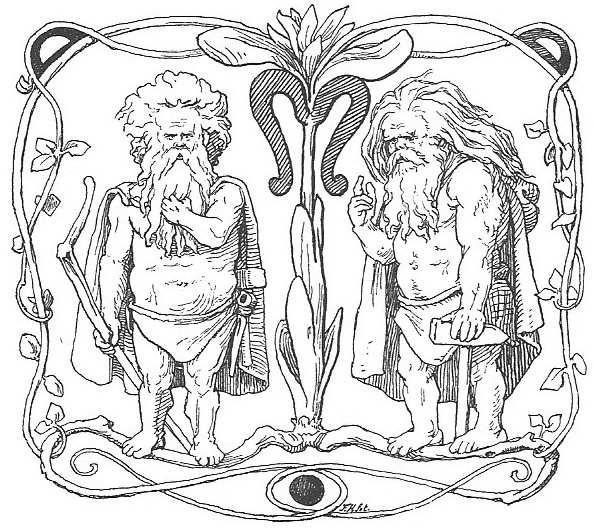
Depiction of Dwarves from a rendition of Völuspá from the Poetic Edda

Some of my long-time readers know that I ran a Nordic-themed adventure path known as the Northlands Saga from 2016 to 2017. It was one of the best long-running games I ran, and I felt passionately enough to give it an in-depth review on several message boards. Although it's been many months since I sailed the frozen shores on dragon-headed ships, the footprints I left behind in fond memories and gaming notes endure. The Lost Runes of the Northlands are a new series of articles intended to expand on the official adventure path, with new material, GMing tips, and revisions where I deem them necessary.

Dwarves as they are in the Adventure Path

Dwarves are one of the iconic races of Norse mythology, but in the Northlands Saga Adventure Path they have a minimal presence at best. They exist in small enclaves in the largest cities of Halfstead and Trotheim, and there are rumored locations of underground kingdoms within the Waldron Mountains and Mount Helgastervän. They helped create four major wonders of the world: the Mead of Poetry, the Forge of Bvalin, the magic ship Skíðblaðnir, and the foundations of the extra-dimensional gateway leading to the Ettielweiss Vale. One of the random encounters with dwarves infer some elements of their culture: they are known as the Dvergar among themselves and the Northlanders, and they are more accepting of magic in their society. In fact, the only named dwarven NPC of major note who appears in the Adventure Path is the ghostly smith Bvalin, who informs the PCs of how to defeat one of the setting's major villains.

Northlands dwarves are very much intended to be a "race of MacGuffins," rarely seen or interacted with save of great import, and whose legacies are found in wondrous creations from earlier eras or to complete some great task. While this is in keeping with the setting's low-fantasy feel, it seems jarring especially when you see that elves, troll and giant-blooded races are viable PC options. And espcially so given the fact that although small in number, their known enclaves are closer to the main Northlands than the elven Nûkland.

Lost Runes Dwarves

History: The Dvergar are creations from the primordial blood of Ymir, the giant whose corpse was fashioned into the world of Midgard. They view their very existence as a blessing, the world around them and its wonders testament to this. Four of their number, named Norðri, Suðri, Austri and Vestri held up Ymir's skull to form the heavens. They are hailed as vigilant heroes among Dvergar, and the four winds said to be their respective breaths.

Their first years were a golden era of peace and prosperity, but this would not last. The Jötnar saw the Dvergar's marvelous creations as the desecration of their progenitor Ymir, and thus began a brutal, bloody war. The great jarl Sindri experienced a vision from the gods to seek out the "chamber of birthed blood" where his people would find both solace and supplies to defend themselves. Sindri interpreted this to mean that the Dvergar must head into the mountains and deep reaches of the earth formed from Ymir's bones, far beneath Yggdrasil's roots where most of their race still live today.

Blessed with ample minerals and endless stone to fashion into great works, Sindri knew his visions to be true, and his bloodline would go on to rule all of dwarvenkind. Although separated from Midgard, the Dvergar still pined for their former homeland and sympathized with the humans and other races warring against the Jötnar. Some of their best smiths and scholars would gift their creations to the gods and mortal heroes.


Lifestyle: The Dvergar live much like feudal subjects in Midgard, albeit in a wholly alien underground environment. Most settlements exist on clumps of earth suspended in Yggdrasil's roots, where fungal matter, stone, and minerals are used to fashion everyday objects. Giant beetles are commonly used as beasts of burden and cattle, while oozes are used for mining and disposing of waste. Dvergar living closer to large bodies of water often grow and raise cave fish, and bats are used much like humans use domesticated birds. Phosphorescent fungi is used as a light source, but only for long-range beacons as Dvergar can see in the dark to a limited range.

The godi of Odin are tasked with passing wisdom to the next generation, and as such Dvergar have a form of public schooling for the purposes of learning to read and write. It is more akin to a godi teaching children within a village or neighborhood than the in-depth multi-tutor structure of our modern world, and most Dvergar learn a proper family trade from their parents.

The marvels of magic and science result in many labor-saving devices; although many Dvergar are limited to the resources at hand on their root-island, it is not uncommon to see steam-powered elevators, dormant golems watching over palace grounds, and for guards to be armed with adamantine-studded crossbow bolts and full plate armor.

Government: The entire Dvergar race is nominally ruled over by the King of Dwarves, an hereditary position whose members trace their lineage to their founder Sindri. Jarls rise from local populations but must pledge loyalty oaths to the King, who in turn uses their taxes to fund large projects and move resources to where it is deemed they are most needed. Dvergar communities beyond Nidavellir, particularly in Midgard, often have a "representative." This is a ceremonial title at best due to an inability to practically enforce a chain of command. Dvergar communities in the Northlands, particularly Halfstead and Trotheim, often obey the laws of the land and make themselves useful to human communities, but in their hearts they know that their true home and lord lies beneath Midgard.

Religion: Dvergar honor the Æsir and Vanir pantheons equally, even giving begrudging worship to Loki for his association with the fire most vital to the art of the forge. Odin is the most popular of the gods, for the Dvergar praise his name whenever they seek the answer to a perplexing mystery or a jarl needs guidance for proper rulership. The finest craftsmen etch his name into magical items and the foundations of marvelous halls. More than a few halls were torn down in times of war, only to be left alone promptly when a vicious bandit or great warrior found praises to the All-Father in Runic among the ruins.

The Ginnvaettir are cursed whenever their names are uttered, followed by furrowed brows and spitting in disgust. The Dvergar hold a special hatred for Thrymr, as he is the only deity among the giants with dwarven worshipers. The frost dwarves are never mentioned save as traitors to their people, forever banished from all the halls of Nidavellir.


Dvergar Characters: Unlike the Northlanders and Nûklanders, Dvergar fully embrace all forms of magic save the ones associated with forbidden gods. They hold magic as the province of Odin, one of his many holy creations since Ymir's fall. They do not make distinctions between arcane and divine magic, viewing all spells as somehow connected to the gods. Bards and skalds call upon Bragi's hymns whether they know it or not, the magical language of wizards hews from the original runes Odin discovered, druids make pacts with minor Vanir of the land, and sorcerers are viewed as the descendants of mortal-deity couplings.

Barbarians exist as religious societies of Odin, but instead of wearing bearskin or wolfskin cloaks they fashion their relics from the hides of giant beetles and aberrations of the deep. Fighters and rangers are always in demand for their ability to defend their people from monstrous horrors, while rogues are typically blacksmiths and mechanics who apply their talents to sabotaging enemy defenses.

Furthermore, Dvergar exist at a higher technological level than the rest of the Northlands. Their status as the best craftsmen in Midgard can open up all kinds of exotic classes, albeit most likely framed in the appropriate mythological context. A dwarven gunslinger PC is a legendary warrior who can "harness the breath of a dragon in a staff which roars with Thor's voice," while an alchemist is a seer of the Mysteries of Ymir, finding the fallen giants' magic in the crude physical matter which surrounds us. Beyond the official Pathfinder sourcebooks, the Path of Iron and Spheres of Might products have some new classes and options themed around advanced fantasy technology.

Banned Classes: Dvergar do not tolerate antipaladins or the worshipers of the Ginnvaettir, and such people are punished by death for treason if discovered. Classes and archetypes which forswear the gods and/or magic as a whole are rare to the point of legend, and such beings often become exiles and outcasts. Vigilantes are unheard of, as maintaining a dual life is often taxing in tight-knit family structures, while a swashbuckler's fighting style is not optimal for Dvergar physiology. Ninja and samurai hail from foreign human cultures far away from Nidavellir and the Northlands, and psionic classes are thematically inappropriate to the Northlands in general.

Dvergar Racial Traits: Dvergar are less anti-magic than dwarves in other lands, so the following alternate racial traits are appropriate for a Northlands Saga game using the Pathfinder rules:

Fey Magic (2 RP): The character has a mystic connection to one terrain type, selected from the ranger’s favored terrain list. The character selects three 0-level druid spells and one 1st-level druid spell. If the character has a Charisma score of 11 or higher, when in the selected terrain, she gains these spells as spell-like abilities that can be cast once per day. The caster level for these effects is equal to the user’s character level. The DC for the spell-like abilities is equal to 10 + the spell’s level + the user’s Charisma modifier. These spells are treated as being from a fey source for the purposes of the druid’s resist nature’s lure class feature and similar abilities. This trait replaces greed and stonecunning. Source: Pathfinder Player's Companion: Heroes of the Wild

Spiritual Support: Dwarves greatly value loyalty in faith, and their gods readily reward them for it. They gain a +1 racial bonus to their caster levels when casting conjuration (healing) spells upon allies. This racial trait replaces greed and hardy.

Stonesinger: Some dwarves’ affinity for the earth grants them greater powers. Dwarves with this racial trait are treated as one level higher when casting spells with the earth descriptor or using granted powers of the Earth domain, the bloodline powers of the deep earth bloodline or earth elemental bloodline, and revelations of the oracle’s stone mystery. This ability does not give them early access to level-based powers; it only affects the powers they could use without this ability. This racial trait replaces stonecunning.

Inspirational Sources:

https://en.wikipedia.org/wiki/Dwarf_(mythology)

https://www.britannica.com/topic/dwarf-mythology

https://norse-mythology.org/gods-and-creatures/dwarves/

Spheres of Power & Might: Converting Noctis


After finishing the Northlands Saga 1.3 years in the making (a very satisfying adventure path I might add), I've been on an extended hiatus from the Pathfinder system. Even so, there are still some books and creative projects which fascinate me enough to briefly dive into that game if only for a curious look. Spheres of  Power and Spheres of Might are two such books, an attempt at making versatile toolbox of abilities to emulate a wide variety of fighting and spellcasting styles to create the character you want.

One of the archetypes known as the Bladewalker brought up strong memories of Noctis from Final Fantasy 15, likely intentionally so. As it combines teleportation techniques with a main class built around using several weapons at once, I theorized about doing a faithful build of the Prince of Lucis.

Important Note: This stat block represents the broad area of plot where Noctis' party is on a road trip in Duscae, after the events at Leide but before his trip to Altissia. As such, he does not have many of his "end-game" abilities and equipment.

Classes: Noctis will be a 5th-level Armiger with the Bladewalker archetype, with 3 levels in Elementalist to replicate his offensive elemancy spells. He will dip 3 levels into Blacksmith for Thunderous Blows so he can sunder the natural weapons and armor of creatures, a common tactical technique in the video game.

Fighting Style: Noctis is capable of warping around the battlefield, using the sudden speed and momentum to dodge attacks and make devastating charges at enemies. Furthermore, he can manifest spectral weapons known as the royal arms which take a variety of forms, sometimes rapidly summoning several at once in a chain of flurries to assault enemies with his entire arsenal.

Noctis is primarily a melee combatant, and his wielded weapons include daggers, swords, greatswords, axes, lances, shields, katanas, tridents, firearms, and some advanced machinery such as the automatic crossbow. As his partner Prompto is better suited to using advanced machinery (and such gear would likely be replicated as magic items or Technician inventions) we'll focus on the more traditional weapons.

For Martial Tradition, Noctis will have Knightly Arts. The bonus proficiencies cover all but katanas, tridents, and firearms. As such weapons in Final Fantasy XV fall into the sword and polearm categories, we can get away with not focusing on them. He also has armor proficiency, but given he doesn't wear armor in the game we're going to reflavor his Princely Raiments into being a hybrid chain shirt/cloak of resistance.

Finally, Noctis will choose the Warleader sphere as a bonus sphere from said martial tradition to gain aggressive flanking ability and the fierce shout in keeping with his teamwork-based tactics from the game.

Noctis' Practioner Ability Modifier will be Charisma. Although he starts out introverted, over the course of the game he learns to appreciate his royal responsibilities and he does have good chemistry with his friends. 

For Spheres and Talents, Noctis will have access to the Warleader sphere along with Armor Training, Knightly Training, and Shield Training as bonus Equipment talents from his martial tradition. He'll also choose Firearm Proficiency so that he can use guns as a bonus Equipment talent from his 1st level in Blacksmith.

Given the fact he zips all around the battlefield, the Athletics sphere is a natural choice. His Athletics Package includes Leap, and for talents he'll have Diving Strike, Expanded Training for Fly and Run, Scale Foe, Wall Stunt, and Whirlwind Leap.

Being able to counter enemy attacks is another important game mechanic, so we'll pick the Fencing sphere; the Boxing sphere is more counterattack-based, but it requires the use of a talent to use with manufactured weapons instead of just unarmed strikes. Noctis' Fencing Talents include Parry and Riposte, and Repositioning Strike.

Total Combat Talents: Noctis has 4 from Knightly Arts Martial Tradition, 1 Equipment talent from Blacksmith's Equipment Specialist class feature, 3 from 3 levels in Blacksmith class, 2 from levels in Armiger class, 4 from the Extra Combat Talent feat gained thrice as regular feats and once as a bonus feat for the 2nd level in Elementalist, and 6 "shadow talents" from his 3 customized weapons.

Magic Style: Noctis' most well-known supernatural ability is the Warp Strike. He can also absorb the power of fire, frost, and lightning from geographical formations to form into spells. Noctis will specialize in the Destruction and Warp Spheres.

Noctis' Casting Ability Modifier will also be Charisma.

 For Casting Tradition, Noctis cannot use elemental magic at will in the game series. He must gather energy at geographic formations and then use portions of said energy to "craft" spells which he can use only a certain amount of before running out. He can use warp strike at will, however, and the Spheres of Power casting tradition/drawback system does not discriminate between certain spheres or types in regards to general drawbacks. However, we know that Noctis can only warp strike when wielding a weapon, and he needs a magic flask to gather materials for elemancy, so Focus Casting makes sense as a drawback. We aren't choosing Galvanized because daggers count as simple weapons in Pathfinder, which Noctis can use with warp strike. Additionally, Noctis' powers are rather obvious in nature when used; so we'll add Magical Signs as another drawback. Regarding his powers in the video game, Noctis can only teleport himself barring one time in the Adamantoise battle where he can teleport allies. As the Adamantoise is an optional boss battle and this does not happen anywhere else, he's going to have the Sphere-Specific Drawback Personal Warp. This is already part of the Bladewalker's archetype class feature, so it works out just fine.

Given that the aforementioned talent costs spell points as a limited resource, a faithful adaption of the game would be to to adapt the Sphere-Specific Drawback Shape Focus for Destruction.


This leaves us with three drawbacks. We'll call Noctis' unique casting tradition The Magic of the Lucii. The two general drawbacks will grant Noctis 1 bonus spell point plus an additional 1 per 3 levels he has in a casting class.

For Spheres and Talents, Noctis' Destruction talents include Fire Blast, Frost Blast, and Shock Blast for blast type talents, and Explosive Orb for the blast shape talent gained from the drawback. I chose Shock Blast over Electric Blast as it is a common element in the game to create magic with debuffing abilities, and the three blast type talents I selected provide deleterious conditions beyond mere damage. Noctis' spells are wide-ranging and indiscriminate, thus the Explosive Orb talent.

Noctis' Warp talents include Distant Teleport, Emergency Teleport, and Quick Teleport for warp talents, and Extradimensional Storage for a space talent gained from the drawback. Distant and Group Teleport covers the speed and length of his Warp Strike, while Emergency Teleport reflects his ability to nimbly get out of danger with it. Extradimensional Storage reflects Noctis' ability to summon weapons out of thin air.

Total Magic Talents: starts out for free in the Warp shere for the Bladewalker archetype, starts out for free in the Destruction sphere for the Elementalist class, 2 from selecting the Extra Magical Talent feat twice, 4 from Elementalist class, 2 bonus talents from taking the Shape Focus and Personal Warp drawbacks.

Now without further ado...the Prince of Lucis' Pathfinder stat block!


Noctis Lucis Caelum
Male Human Armiger 5/Blacksmith 3/Elementalist 3
NG Medium Humanoid (Human)
Init +6; Senses Perception +13
--------------------
Defense
--------------------
AC 21, touch 14, flat-footed 19 [+7 armor, +2 dexterity, +2 deflection]
hp 105
Fort +15 Ref +14 Will +10 (+12/+11/+7 without Prince's Fatigues)
--------------------
Offense
--------------------
Speed 30 ft.
Melee Drain Lance +17, Normal Attack (1d8+7, x3)
Drain Lance +14, Power Attack (1d8+16, x3)
Engine Blade +17, Normal Attack (1d8+7, 19-20/x2)
Engine Blade +14, Power Attack (1d8+13, 19-20/x2)
Force Stealer +17, Normal Attack (2d6+7, 19-20/x2)
Force Stealer +14, Power Attack (2d6+16, 19-20/x2)
Rapid Assault First Strike +15, Normal Attack (damage varies)
Rapid Assault First Strike +13, Power Attack (damage varies)
Rapid Assault Second Strike +13, Normal Attack (damage varies)
Rapid Assault Second Strike +11, Power Attack (damage varies)
Ranged Fire/Frost Blast (6d6+1 fire/cold, DC 15 Reflex halves), Shock Blast +12 touch (6d4+1 electricity, DC 15 Reflex halves)
--------------------
Magic
--------------------
Caster Level +5; MSB 8; MSD 19; Concentration +11
Tradition Magic of the Lucii; CAM CHA DC 15
Spell Points 8
Spheres Destruction (Fire Blast, Explosive Orb, Frost Blast, Shock Blast), Warp (Distant Teleport, Emergency Teleport, Extradimensional Storage, Quick Teleport)
Drawbacks Focus Casting, Magical Signs, Personal Warp (Warp Sphere Specific), Shape Focus (Destruction Sphere Specific)
--------------------
Might
--------------------
Martial Tradition Knightly Arts; PAM CHA, DC 18
Talents Athletics (Fly, Leap, and Run packages, Diving Strike, Expanded Training [Fly and Run], Scale Foe, Wall Stunt, Whirlwind Leap), Equipment (Armor Training, Firearm Proficiency, Knightly Training, Shield Training), Fencing (Parry and Riposte, Repositioning Strike), Warleader Sphere
Customized Weapons Noctis is capable of utilizing a wide variety of weapons on his person. Although he can only have 3 active at a time, here are a few suggestions for weapons and their bonus talents by type:
Daggers (Dual Wielding Sphere, Mercurial Flow)
Firearm (Barrage Sphere, Distracting Shot)
Greatsword (Guardian Sphere, Sweeping Defense)
Longsword (Fencing Talents: Footwork, Group Cover)
Polearm (Lancer Sphere, Double Impale)
Shield (Shield Sphere, Flexible Cover)
Sniper Rifle (Sniper Sphere, Push Shot)
--------------------
Statistics
--------------------
Str 18, Dex 14, Con 14, Int 10, Wis 10, Cha 16
Base Atk +10; CMB +14; CMD 26
Feats Craft Wondrous Item (class B), Endurance (smith insight B), Extra Combat Talent x4 (class B), Extra Magical Talent x2, Improved Initiative, Power Attack (race B), Toughness (smith insight B)
Skills (55 points) Acrobatics* 11 (+16), Bluff* 11 (+17), Climb* 11 (+18), Diplomacy* 5 (+12), Escape Artist 4 (+9), Fly 11* (+16), Knowledge (Local) 8 (+11), Knowledge (Nobility) 8 (+11), Perception 10 (+13), Profession (Fisherman) 10 (+13), Stealth 5 (+10), Survival 10 (+13)
*Bonus skill points gained from Spheres
Traits Deft Dodger (+1 Reflex saves), Prince (+1 Diplomacy, class skill)
Languages Common
SQ Artisan Savant, Customized Weapons (3), Enhanced Customization (+1), Evasion, Favored Element (Explosive Orb, +1 damage), Maintenance (3 allies), Prowess (Mobile Assault), Quick Change (2/round), Reforge, Skilled Craftsman (+1 Profession Blacksmith), Smithing Insight (Durable)
Gear 2,000 GP, Drain Lance** (+2 Spell Storing Lance), Engine Blade** (+2 Spell Storing Longsword, customized weapon), Force Stealer** (+2 Spell Storing Greatsword), Prince's Fatigues (acts as +3 Cloak of Resistance and +3 Chain Shirt), Carbon Bangle (acts as Ring of Protection +2)
**function as customized weapons and thus have a +1 higher enhancement bonus than their listed description
Favored Class Armiger +5 HP
--------------------
Special Abilities
--------------------
Special Attacks

Blade's Path (Su): Whenever Noctis successfully damages an enemy or object with an attack made with one of his customized weapons, he may spend 1 spell point as an immediate action to instantly teleport to an unoccupied square adjacent to the target of that attack. When using this ability Noctis may also instantly recover a thrown weapon used in the attack as long as he has a hand free; ammunition that is destroyed or consumed by a successful attack cannot be recovered in this manner.

Diving Strike (Leap Talent): Noctis may charge an enemy by rapidly descending from above them. If the attack at the end of his charge hits, the attack deals damage as normal and also adds the appropriate amount of falling damage (1d6 points for a 10-ft. fall, 2d6 points for a 20-ft. fall, and so on), to his damage roll, to a maximum of 10d6. This falling damage is not multiplied on a critical hit. After the attack is resolved, Noctis lands in an unoccupied square of his choosing adjacent to the target, and he takes falling damage as if you had fallen 10 fewer feet.

Fatal Thrust: Whenever Noctis makes an attack action or an attack of opportunity against a target that is within 30 ft. and that he is flanking, that is flat-footed, or that has lost its Dexterity bonus to AC (such as through a successful feint), he deals an additional +3d6 precision damage to the target. This damage is not multiplied on a critical hit. Noctis may apply the effects of a single (exploit) talent to any fatal thrust.

Fire/Frost/Shock Blast, Explosive Orb: With the expenditure of a spell point, Noctis may deliver a burst of magical elemental force as a ranged attack within 35 feet with a radius of 15 feet. The blast deals 6d6+1 damage with a Reflex save for half damage. The energy type may be cold, electricity, or fire. If fire, affected targets catch on fire on a failed Reflex save. If cold, they are staggered for 1 round on a failed Fortitude save. If electricity, the damage is 6d4+1 and the targets are dazed for 1 round on a failed Fortitude save. The respective save DCs are all 15.

Focusing Switch: While Noctis is using his active weapon and whenever he succeeds on a combat maneuver, confirms a critical hit, or reduces a foe to 0 or fewer hit points, he may regain martial focus by activating a different customized weapon as an immediate action, stowing the current weapon and drawing the new one as needed.

Parry and Riposte: When a creature makes a melee attack against Noctis, he may expend his martial focus and use an attack of opportunity to attempt to parry that attack. Noctis makes an attack roll as if he were making an attack of opportunity, but for each size category the attacking creature is larger than him, he takes a –2 penalty on this roll. If Noctis' result is greater than the attacking creature’s result, the creature’s attack automatically misses and Noctis regain his martial focus or choose to instead make a single melee attack against the parried creature.

Rapid Assault: Noctis is an expert at rapidly integrating multiple weapons into his attack routines. Whenever he successfully damages a creature or succeeds on a combat maneuver while using the attack action with a customized weapon, he may expend martial focus as a swift action to make an additional attack against that creature at his highest base attack bonus. This attack takes a -2 penalty on the attack roll and can only be taken with a customized weapon other than the one used in the triggering attack. If that attack is successful, he may make an additional attack and must use a different customized weapon at a -4 penalty. Noctis may spend a move action to move up to his speed between the triggering action and his additional attack, dividing up the attacks at any creature he can reach among the movement.

Additionally, if Noctis does not have a move action available, he may still move up to his speed as if he spent a move action, but ends up staggered on his next turn.

Repositioning Strike (Exploit Talent) : With a fatal thrust, Noctis causes the target to stumble, nimbly slipping past them. Noctis may immediately move up to half his movement speed as a free action, so long as he end his movement in a space adjacent to the target, and may even move through the target’s occupied space when doing so. This movement does not provoke attacks of opportunity from the target.

Thunderous Blows (Ex): Noctis is particularly adept at striking crafted creations in exactly the right place and manner to damage them most effectively. He never provokes attacks of opportunity for attempting the sunder combat maneuver, and deals an additional 2d6 damage to the struck equipment on a successful sunder attack. If the amount is enough to destroy the equipment, excess damage is dealt to the wielder. Noctis may also sunder natural weapons and armor, inflicting  a -2 penalty on natural armor bonus and/or attack rolls. The natural armor penalty lasts until the target receives magical healing or a DC 15 Heal check, while the attack roll penalty lasts for 1 round.

Thursday, February 1, 2018

Review: Deadly Delves Reign of Ruin


Reign of Ruin is a 34 page adventure for Swords & Wizardry by Jon Brazer Enterprises, suitable for a party of 6th level PCs. In terms of transparency I received a complimentary copy for review purposes.

The book opens up with some starting fiction and background. The background is a set-up for the adventure, where the descendant of a long-dead black dragon tyrant mobilizes her minions to menace the warm-blooded races who her forebear terrorized so long ago. The backstory is a bit wordy and rather specific with proper names and regions. I feel that it could be shortened considerably to be more generic for the purposes of individual campaigns.

As for the present era, the plot hook for the party to get involved is via a scout’s last dying words of the razed city of Northam and its need for reinforcements. The other hook involves traveling merchants explaining in more detail that the Ixtupi (lizardmen devotees of the black dragon) have come to attack the village as revenge. Once the PCs get to the town, they find it in the aftermath of a massacre, with a few clues pointing to the identities and motives for their attackers in the form of a survivor’s testimony and draconic graffiti. The clues give a relatively good sense of the opposition for a canny group of players (corpses whose flesh seems to have dissolved off their bodies which is the result of acidic breath weapon), but overall I feel that this adventure could have had a stronger start if it began proper with the party arriving in the town. The merchant adventure hook is too much “tell, not show” and ideally the site of an attacked settlement alone should be enough to attract the PC’s attention.

Further encounters before the main dungeon itself include the village of Mistlevy (the raiders’ next target) and a swamp encounter where the Ixtupi are fighting a rival tribe of lizardfolk. In both of these encounters there is quite a fair number of enemies, but also potential allied NPCs to fight alongside. This does a good job of preventing characters from feeling overwhelmed, but on the other hand risks the GM rolling “against himself” a fair bit if their gaming group is slower-paced. A good idea may be to grant the players the opportunity to control said NPCs; I did this in various campaigns, which made my gaming group feel more engaged with the battle.

Additionally the first encounter has a point where the black dragon main villain makes a personal appearance to wreak havoc before fleeing back to her temple headquarters. The intent of the adventure is that the party will face her down in the heart of her lair, with the first encounter as a taste of things to come. Although mobile and strong like many dragons, the old adage “if it has stats, the players can kill it” holds strong. A bad saving throw or lucky attacks may bring the dragon down at the outset, and given that the final encounter is a pretty clever room full of terrain-based hazards, this would be robbing the gaming group of a good fight later on down the road.

The temple itself has three major levels not counting the aboveground entryway. It has a healthy mix of reptilian monsters, undead, animated objects, and other creature types to prevent combat from getting too monotone. The dungeon is the meat of the adventure, and there are quite a few traps. There was one trap that I liked but felt could have been executed better: stone pillars which summon corrupted elementals if a spellcaster uses magic which deals energy/elemental damage while within their vicinity. It takes an otherwise common tactic of “blast them all” to use against the party in a thematically interesting way. Unfortunately said trap is a one-time occurrence so that it is likely to happen without the players growing aware as to their purpose. A repeat appearances of pillars would engender a cautious mindset in players; they would need to weigh whether they risk using powerful magic against the enemies currently arrayed against them, but at the possibility of biting off more than they can chew. Another involves a room which fills with acidic water while dragonblood brutes (who are themselves immune to acid) attack the party. A hidden lever can be found during combat to drain the room. I particularly like this touch; it combines monsters and environmental hazards together in a way I don’t see often in many OSR modules.

As for enemies, there are mentions of what happens if the complex goes on alert, notably in the form of kobold slaves acting as messengers. However, most of the intelligent monsters rarely go beyond their own rooms and instead prepare to attack PCs who come to them first. This feels a bit artificial, and while it makes sense in some cases (unintelligent undead and constructs) it would’ve been nice to have suggestions for what rooms monsters would retreat to or use as chokepoints in case of an invasion of the temple. Lord knows the complex has enough traps to exploit for this purpose!

The final encounter with the black dragon overlord has a good description of the room in which the battle will take place, with descriptions of terrain for both the party and for the dragon to use to their advantage.

Miscellaneous Thoughts: The maps for this adventure are well-detailed. Full-color and grid-based, they cover the entirety of the main dungeon as well as the first encounter. The adventure also makes clever use of existing class features. The “Open Doors” roll, for example, is used for various feats of strength such as escaping from the grip of a giant venus flytrap or pushing a fallen stone block trap to reopen a passageway.

The adventure itself is rather expensive for its size ($10 for a 34 page adventure). Given that adventures have limited replay value for gaming groups, this reduces its viability in comparison to other Swords & Wizardry products of similar length but at more affordable prices. I understand the need to make up costs especially given the detail of the maps, but as a consumer it will not be an attractive option.

Clarification: The book's price as a PDF dropped to $6.95

In conclusion, Deadly Delves: Reign of Ruin rates well for an OSR adventure. It has the core idea of a dungeon delve, but the terrains, traps, and enemies are varied and well-detailed enough to keep the players on their toes. Its low points are that the BBEG shows up too early (and thus risks the potential for an early death), as well as the fact that temple has a high enough number of traps to the point of triggering player paranoia which can slow gaming to a crawl. But overall the good outweighs the bad in this dungeon crawl. My final verdict is a 3.5 out of 5 stars, rounded to 3 for the purposes of OneBookShelf.

Sunday, December 17, 2017

A Belated Farewell


Hello everyone. As you are aware, I've been on a blogging hiatus. Looking at the last entry from August 27th really hit home how long it's been. There's a variety of personal reasons for my slowdown, but the biggest issue is that my creative well has run dry for things to write about. I could write whatever seems catchy or comes to my head, but the last thing I want is to turn into a tabletop news aggregate churning out clickbait. I may come back if I feel the muse return, but I cannot predict when that will happen.

I am happy that for the past 3 years my writings provided entertainment and inspiration to fellow gamers. From homebrew to rewrites to topical issues I covered a wide range, and I feel that my own creative writing grew all the stronger thanks to it. It's been a good long ride, and I hope to meet you all once again on the foggy road that is the future.

Sunday, August 27, 2017

Dragons of Renewal DL9: Dragons of Deceit


by Larry Elmore


Overview

After recuperating from the Battle of the High Clerist's Tower, the party is approached by D'argent/Silvara in her disguised form. She tells them that they must head out to the city of Sanction in the heart of Takhisis' empire. The key to the good dragons' Oath of Neutrality is there, and if successful can help bring them into the war against the Dragonarmies. Silvara is tight-lipped about the specifics, not letting up about the nature of the draconians' creation until the PCs see for themselves. The party has a choice of going by sea or by land, both paths with their own encounters along the way.

Whether by imprisonment or infiltration, the party has the opportunity to find out the truth in the Temple of Luerkhesis where a Black Robe wizard, a cleric of Takhisis, and a red dragon conduct a ritual to transform metallic dragon eggs into draconian spawn. The PCs may encounter the Shadowpeople, a secretive race living beneath the city who can aid their escape as the draconian chamber sets off magical alarms to send a group of soldiers to kill the intruders. If the PCs escape into the shadowpeople chambers, they'll be teleported to the hidden island where the metallic dragons live. Once informed of the Dragonarmy's true use of their children, the Oath of Neutrality is broken and they fly south with the heroes to Palanthas to lend their aid to the forces of Good. The PCs will have opportunity to ride on their backs with Dragonlances in tow during an assault on the city of Sanction.

Victorous, there is only the final city of Neraka to conquer, where the two once-split parties of Winter and Spring unite for one last battle against the forces of evil!

Things to Change/Look Out For


D'argent/Silvara: Interestingly, the AD&D version of the module suggests handing over control and accommodating backstory notes of the silver dragon to a player as a one-time thing for the adventure. Instead of controlling 2 PCs at once, the player gets to control the dragon in lieu of their normal PC. Be it AD&D or 3.5, she will doubtless be along for the ride albeit mostly in a humanoid form. Having a player run her is a good idea, albeit with the caveat that she will not take dragon form save at a dramatically appropriate moment (like escaping with the good dragon eggs or such). You might also want to allow the player to control their PC if they think they can manage both adequately.

In AD&D terms, dragons are nowhere near as strong as they are in 3.5, so in the latter there's a chance that even in a weaker humanoid body Silvara can be a powerful character. Consider making a level-appropriate stat block for whoever she is intended to be disguised (wizard, fighter, etc).

As recommended in my last blog post, I had the mission known immediately from the outset along with a threat from Ariakas to turn herself over or else more metallic dragon eggs will be squashed for every day that passes. This provides a good hook and motivation, and it's possible the players at this point in the campaign are putting two and two together regarding the reasons behind the Oath.

"No metallic dragons, the draconians all have their scale colors...something seems fishy here.

Travel: The trek to Sanction by land or sea is going to be long, and there's lot of unrelated encounters along the way. Some of them can be fun, such as running through a Dragonarmy blockade to get to Sanction's port. But at this level, and assuming that time is of the essence, the PCs may very well resort to teleportation, long-term flight (via summoned monsters or spells), or other means to bypass regions. In my own campaign I had the PCs abscond with supplies from the White and Red Robe army camps around the High Clerist Tower. This was done to get the spell components to teleport, a very powerful magical spell even in higher-magic settings. The meat of the plot and drama takes place in Sanction, so it may be a good idea to speed up the process or excise it entirely unless your group likes the idea of overland travel with lots of events.


Sanction: In the original adventure, Sanction was a sprawling city amidst an active volcano, much like Mordor. The majority was rundown, with shantytowns and tent-cities from the large influx of mercenaries, draconians, and other wicked folk. The temples, relics of pre-Cataclysm times, are the exception and now used as military stations and meeting points for Dragonarmy VIPs.

In my own campaign, I changed the aesthetics a bit. Sanction was still near an ashy mountain range, but Ariakas wanted the heart of his empire to reflect the beauty of old Istar. There was a large colosseum built in town, both for him to make grandiose public speeches as well as blood sport for entertainment. The city was vertical: the lowest tiers contained the slums and shantytowns while the higher tiers more well-to-do sections with the temples, manors.

The effects of the Dragonarmy rhetoric were present. Drakenheim Academy was where the younger generation of citizens were taught propaganda of the new order. With the aid of clerical magic and the Black Robes, there were ample magical resources as well. When my PCs arrived in town, a set of skulls atop poles acted as a sort of magical broadcasting system to echo Ariakas' speech from the colosseum so that all citizens may hear it. A pair of children ran down the muddy street, one of them displaying a minor bit of clerical magic with youthful wonder while wearing a Medallion of Takhisis.

I made a full transcript of Ariakas' speech here, cribbing notes from real-world dictators (mostly Hitler and Stalin), albeit altered to fit the circumstances of Krynn. I had lines from it interspersed throughout the adventure as the PCs went about Sanction rather than reading it all at once. It may not work if any of your players are familiar with the speeches, but it worked well for my group in making Ariakas an intimidating yet well-spoken figure.

The draconian birthing chamber had a separate room for ones born with deformities, a sliding shoot leading down to a cavernous room to be devoured by slimes (which the PCs saw and put a stop to in saving one from such a fate).

In this way, Sanction was a gilded city. It echoed the glories of a grand and civilized society, but only its trappings. For beneath the thin paint of gold, evil and tyranny could be found.


Interior Artwork from Dragons of Deceit, AD&D Version

Early Encounters with Ariakas: There are 2 opportunities the PCs may meet the Emperor of Ansalon earlier than the final chapter of the Dragonlance Saga. The first is during a public parade in Sanction where he's driving a chariot drawn by human slaves. Kitiara and 20 bodyguards are at his side during this. Another if the PCs get captured and are interrogated in the Temple of Luerkhisis.

The 3.5 version says that even if Ariakas is to die, his body will be taken by guards to one of the temples where he will be resurrected via dark rituals. Although done to prevent a premature victory, it takes a bit of the sense of accomplishment out of the equation. Like the old adage of "if it has stats, players can kill it," you may wish to avoid having the Emperor appear early. My skeleton pole system still gave off his presence while not being physically present, and the PCs were preoccupied with saving the good dragon eggs instead of assassinating the Emperor. As a result, things worked out for my campaign this way.


Two-Page Splash of the Battle of Sanction in the 3.5 version


Discovery, Escape, and the Final Encounter: I admit that my own campaign's progress went very differently from the standard adventure. For one, Silvara teleported away with the good dragon eggs to the Isle while the rest of the PCs fought their way out. They were challenged to battle on the streets of Sanction by their Kitiara Counterpart NPC, who they were intent on saving from what they thought was Ariakas' brainwashing.  Fighting her on top of her dragon, the rest of the city's chromatics gave pursuit with the Green Dragon Highlord Salah-Khan at their helm (what can I say, our Dragonlance was a lot more high-octane than usual). The battle/pursuit was later joined by a flight of 30 metallic dragons led by Silvara in dragon form to counter their assault. The battle mat was a riotous assembly of good and evil dragons which PCs could ride or run on, fighting other riders and the Dragon Highlords. It had the climactic feeling of the standard final encounter, albeit with a clear "boss" for the PCs to fight rather than nameless dragons and soldiers.

In your own games, you might consider going with the standard adventure, or just have the 12 nameless dragons with an undefeated Dragon Highlord at their command (Kitiara Counterpart is highly appropriate for this). Furthermore, the PCs might attempt to escape with the good dragon eggs themselves (there's a lot of them) by piling them into Bags of Holding or as much as they can carry to get word out. Or maybe the latent anti-divination magics concealing the dragon eggs' location is removed once the PCs are out of the Temple, allowing the metallic dragons to come to their aid right then and there.

But regardless of what you do, don't deny your PCs the opportunity to ride on dragons!

Closing Thoughts

Dragons of Deceit is a very good conclusion to the Dragons of Winter arc. The major areas to work on include the primary motivation, how to handle Silvara's role, and giving an "enemy face" of an important NPC in the final battle. Otherwise the adventure works quite well.

Next time, we shall start on the first chapter of the Dragons of Spring arc, Dragons of Dreams!

Tuesday, August 22, 2017

The Martial Disciple: a pseudo-Vancian fighting class for 5th Edition


Hey folks. I realize that it seems I dropped off the face of the Internet blogging-wise. Much of the blame is other projects sucking away my time to commit. But fortunately the fruits of my labors resulted in a new book for Dungeons & Dragons Fifth Edition! As one raised on the 3rd Edition of Dungeons & Dragons, I am a big fan of options in games no matter the character concept. And while there are good parts in 5th Edition, the noncasting martial classes felt rather 'blah' in terms of things to do beyond basic attacks.

The Martial Disciple is, in short, a new system inspired by Tome of Battle/Path of War with special moves known as techniques. Techniques are akin to spells in that they are limited-use abilities which play off of the short/long rest and are grouped into 8 fighting schools based on style and thematics. There is a new eponymous class which draws off of this system as well as 5 archetypes for existing core classes to get in on the fun.

Techniques: Much like Path of War or Tome of Battle, you have Strikes which are offensive in nature; Counters, which are reactions triggered by attacks and effects; Boosts, which are 'buffs' to your abilities; and Stances, which are long-term buffs which last indefinitely but you can only choose one to use every long rest. Fighting schools represent groups of related abilities: Reaper's Field is optimized for heavy weapons and overwhelming force, Prowling Panther relies on trickery and misdirection, and Alchemic Warrior revolves around personal serums, bombs, and debilitating chemicals.

Class: The new class is the same as the book's title, meant to represent a sort of generic warrior akin to the Fighter save that they interact heavily with techniques. Unlike the Fighter they designate one of three mental ability scores as their Martial Ability akin to a spellcaster. Intelligence represents tactical masterminds, Wisdom for ascetic and hunter types, and Charisma for inspiring leaders and the like.

Archetypes for the Martial Disciple include the Avatar of War, who has a supernatural connection to a planar realm of conflict and can call weapons and figures from said realm; the Challenger, a seeker of self-improvement who can sense the strongest opponent on the battlefield and turn enemy attacks and strength against them; and the Wandering Stranger, who has a bit of a Clint Eastwood vibe with an offensive staredown and a limited legend lore used for gathering rumors said about themselves.

Archetypes for existing core class include:

Commando for the Rogue who specializes in misdirection and special operations style tactics such as being able to gain a floating tool proficiency reflecting training for specialized missions.
Daredevil for the Rogue who is all about flair and panache. Can do things like move through vertical spaces and open air as difficult terrain as long as they have rope for swinging or gambits where you voluntarily impose disadvantage on a roll in exchange for a potential boon if successful.
Path of the Destroyer for the Barbarian (think Juggernaut from X-Men), who is all about building up momentum and mobility while raging for self-buffs like freedom of movement (unstoppable object) or passwall effect (breaking through walls).
Tactician for the Fighter who can trade out a saving throw proficiency during a long rest for adapting to one's environment, adding proficiency bonus to skills related to soldiery matters, and the like.
Way of the United Spirit for the Monk who specializes in Alchemic Warrior and Trance Dancer (spirit-possessed warrior) who uses alchemy and esoteric religious rituals to push their body and mind to its maximum potential.

Hopefully I ignited your interest in my book. It was a fun thing to make for me, and I hope it is even more fun for you to use at your gaming table! You can find it below on these online storefronts:

Drive-Thru Link.

RPGNow Link.

Open Gaming Store Link.

Thursday, June 22, 2017

The Northlands Saga, Part Four: Beyond the Wailing Mountains


The destruction of the Second Temple of Ice and Stone did not go unnoticed by the Children of Althunak, for the frozen corpse of Aluki's brother Kelvani was sent back to the village of Laquirv along with a monstrous raiding party around early spring. Thankfully our heroes were staying the winter while the Long Serpent headed back to pick them up in a few months, and the cult's assault failed thanks to their efforts. One of the faithful, a woman enhanced by the demon-god's magic and clad in illusory armor designed to make her look undead, was taken alive and enchanted by Syrasi to reveal that they came from a city on the other side of the Wailing Mountains.


After retrieving the sacred weapons from Hero's Rock again, Aluki volunteered to lead the party across the Far North given the danger of the terrain. Along the way, Vigbjorn challenged a woolly rhinoceros to a valiant battle, and in the mountains fought an over-eager frost giant guarding the pass for the cult. What lay ahead after these trials was a deathly cold wasteland where the sun never sets.


The City of the Lord of Winter was grand in size, yet entire sections of town lay abandon. The covering the south, west, and east sides had a mixture of humans (with endure elements) and demonic guards keeping watch. The party used their magical folding boat to traverse the lake at its north, upon which the First Temple of Ice and Stone proudly rose from the lakebed. Climbing up subtly, they overheard a conversation between Elvanti, the leader of the Children of Althunak, and Karnak Seven-Sorrows, a servitor demon.


Elvanti welcomed the party, and being rather curious asked the party what promises the Ulnat gave that he couldn't possibly give. Syrasi's answer ("there are people among them who care for me and I care about") infuriated him, whereas Askeladden's answer was more practical ("you tried to have me killed several times"). At this point Karnak teleported into the room to aid his lord, and the battle just begun!


Althunak's Chosen proved more than a pushover, for in addition to being a strong warrior he also could turn nature itself against his enemies by summoning ice and lightning storms. Thanks to the many open skylights in the main temple area, he caught the heroes by surprise this way. Even in defeat he was unbowed, mocking Vigbjorn right before the trollkin cut him in half. The demon Karnak Seven-Sorrows, meanwhile, gave a mocking salute to the statue of Althunak in leaving his service right before he got dismembered.

The party looted the temple's treasure room, and freed a dozen Ulnat prisoners planned to be used as bargaining chips. But the rest of the cult was not idle, and six cultist warriors with a pair of ice demons came rushing in via the south. Thanks to some preparation of bear traps and a decoy unseen servant, the party broke their ranks with a well-timed glitterdust and good old-fashioned physical combat!


Once the cult's best forces were felled, the PCs fled the temple to notice the rest of their forces in disarray. Demons screamed and teleported away, while mortal faithful were fighting among themselves for leadership. Although the demon-god still exists, his reach in Midgard was shortened considerably. A victorious party ventured back across the Wailing Mountains to the Seal Coast, where grateful Ulnat awaited them along with the crew of the Long Serpent.

Awaiting them back at Silvermeade Hall was Inga, Henrikson's eldest daughter and now Jarl of the town. She apologized for her earlier arrogant ways back in Spring Rites, and brought up the old deal she had with Hallbjorn before his loss at sea. Hallbjorn promised to donate 10 percent of loot to the families of warriors who were injured and perished as a result of the war against the Children of Althunak. Although she didn't press the issue, Askeladden was less amenable to the deal. The rest of the party honored their comrade's promise and donated their share.

GM's Notes


In the original adventure, several of the Children of Althunak's minions were female prisoners transformed into monsters known as snow brides. One of the brides who attacks the village of Laquir is Klinqa, the woman who first rebuffed Elvanti's hand in marriage. Given that this had overtones of sexual assault a few of my players would not appreciate, I changed the "snow brides" into generic minions disguised as undead so as to get fighters to waste the wrong spells on them.

Karnak Seven-Sorrows was a character of my own creation, a babau demon. Replacing two snow brides in the final fight, I figured a teleporting demon would make for a good combination with Elvanti's weather control magic. Elvanti's appearance was also different. In the original adventure he was transformed fully into the Chosen of Althunak, appearing like a huge furred emaciated monster. I kept the same stats, but otherwise had Elvanti appear as a medium size human with a reach weapon. There wasn't much reason for this aside from aesthetics and wanting to give a "human face" to the major villain of the Far North adventure arc.

The folding boat helped the PCs bypass much of the encounters gained if one went through the ruined city via the front gate. I made up for that with cult reinforcements upon Elvanti's death.

I forgot to tell the PCs about the initial 15% agreement from Hallbjorn's voyage back in Vengeance of the Long Serpent. I figured introducing it here could be a good test of their character.

I'm sorry for the long-overdue update for Northlands, but I hope you enjoyed reading it. Our next adventure takes our heroes all around the region to end a death-curse from the legendary reaver Sven Oakenfist!